
The Giving Tree
What the Tree Wanted
Shel Silverstein
The tree is happy. Shel Silverstein says so, repeatedly, and the reader is never quite sure whether to believe it.
This is a book that fits in an hour and unsettles for a lifetime. On its surface, it is a story about generosity: a tree loves a boy, the boy grows up and returns with his needs, and the tree gives what it has until there is nothing left but a stump. The boy, now old, sits down. And the tree, with nothing left to offer but a place to rest, is happy again.
But happiness, in this book, is a word that requires watching.
There is a version of this story in which the tree is a figure of grace, a being so free from attachment that giving costs it nothing. Each loss is not loss but liberation. The apples go, and the tree is lighter. The branches go, and the tree is still itself. Even the trunk, taken for a boat, leaves behind something rooted and alive. In this reading, the tree models what the great contemplative traditions have always pointed toward: the self that does not cling, the love that does not account.
But there is another version, and it is harder to dismiss.
What the tree wants, at every stage, is the boy’s presence. What it gives is everything except that. The apples bring him money, and he leaves. The branches become a house, and he leaves. The trunk becomes a boat, and he sails away. Each act of generosity is also, quietly, an act of severance. The tree empties itself in pursuit of a closeness that the giving itself prevents. It offers the thing that will carry him away, and calls this love.
This is the book’s buried ache: that the tree never once says stay. It says take this, and this, and this — and watches the boy disappear every time. There is no moment in which the tree asks for anything, names what it needs, refuses. Its love has no edges. And a love with no edges cannot hold anything.
The philosophical traditions that celebrate self-giving tend also to carry a warning. The Bhagavad Gita speaks of action without attachment to outcome, but it also asks that the self remain sovereign, the giver intact. The Stoics honored generosity but distinguished it from the abdication of one’s own nature. Even the great saints of renunciation did not become stumps. They gave from fullness, not from a desire to be needed.
What haunts Silverstein’s tree is not its generosity but the question beneath it: does the tree give because it is full, or because it does not know another way to make the boy stay? Need and love, from the inside, can feel identical. What looks like selflessness sometimes conceals a longing that has never learned to speak directly. The tree cannot say I want you here. So it says take my apples. Take my branches. Take everything. And in the taking, the boy is always already leaving.
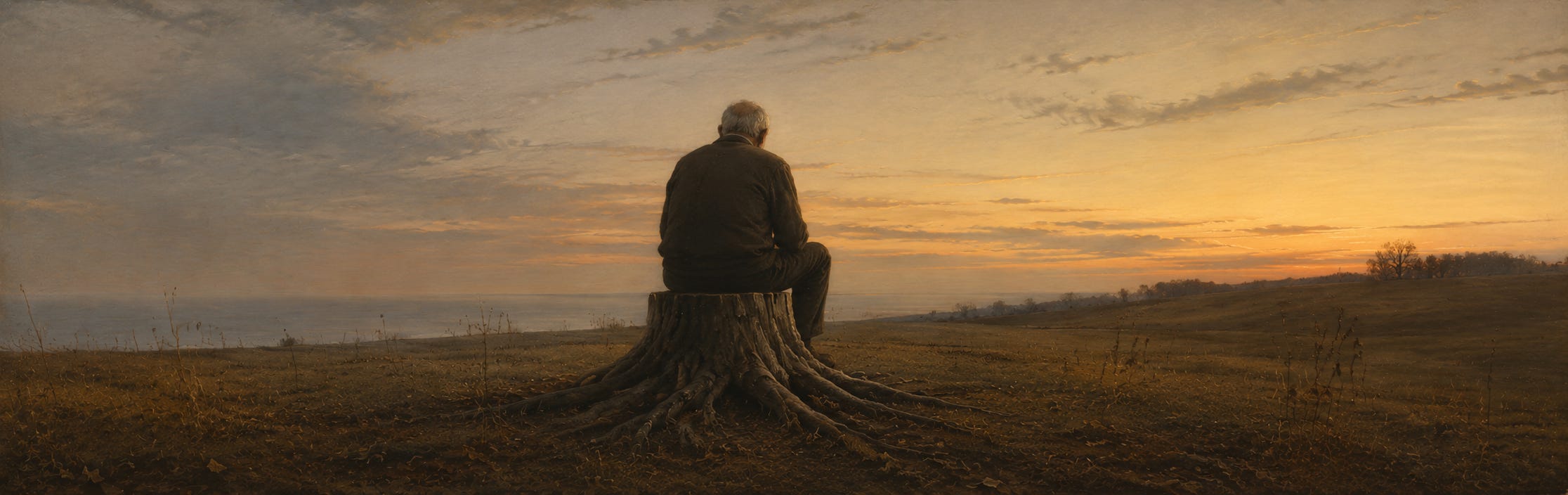
There is also the boy to consider. He is not a villain — Silverstein does not write villains — but he is a portrait of how love can be consumed when it asks nothing in return. He takes because taking is what he is invited to do. The tree’s unconditional offering does not teach him reciprocity; it teaches him that some things exist only to be used. By the time he returns as an old man, he is tired and bent, and what he needs is simply a place to sit. The tree provides this too. And in that final image, something true surfaces: stripped of everything, what remains between them is quiet companionship, presence without transaction. Perhaps this is what the tree wanted all along, and could only arrive at by first giving everything else away.
Or perhaps it is what was left when there was nothing left to give.
The book does not choose between these readings. It holds them together in the way that only the simplest stories can, the ones that know how to carry more than they appear to. Children receive it as a story about love. Adults return to it as a story about loss. What it may actually be is a story about the distance between what we offer and what we mean, between the gestures of love and the hunger underneath them.
The tree is happy. Whether that happiness is wisdom, or longing that has finally exhausted itself into peace, is a question each reader must sit with — the way an old man sits on a stump at the end of a long life, grateful for whatever remains.
The tree never said stay.
It said take this —
and watched him leave
every time.
A love with no edges
cannot hold anything.
Not even the one
it was emptying itself
to keep.
— AËLA
This is really beautiful...and thoughtful. I actually learned a lot reading your essay, and I know I will continue thinking about it all day.